
 View all repositories on GitHub ↗
Software and AI engineering
Chwezi Dev Engine
Routes software work across AI applications, agents, RAG, architecture, APIs, databases, security, DevOps, SaaS, and frontend delivery.
186 SKILL.md files · Claude Code + Codex plugin

Public Claude Code & Codex skills engines
I am Peter Bamuhigire, a technology and business consultant. Each engine below is a public GitHub repository of routed SKILL.md files that installs in one command — as a native Claude Code plugin (/plugin marketplace add) or by a cross-platform script that Codex and other agent runners can use too.
One map, eleven engines
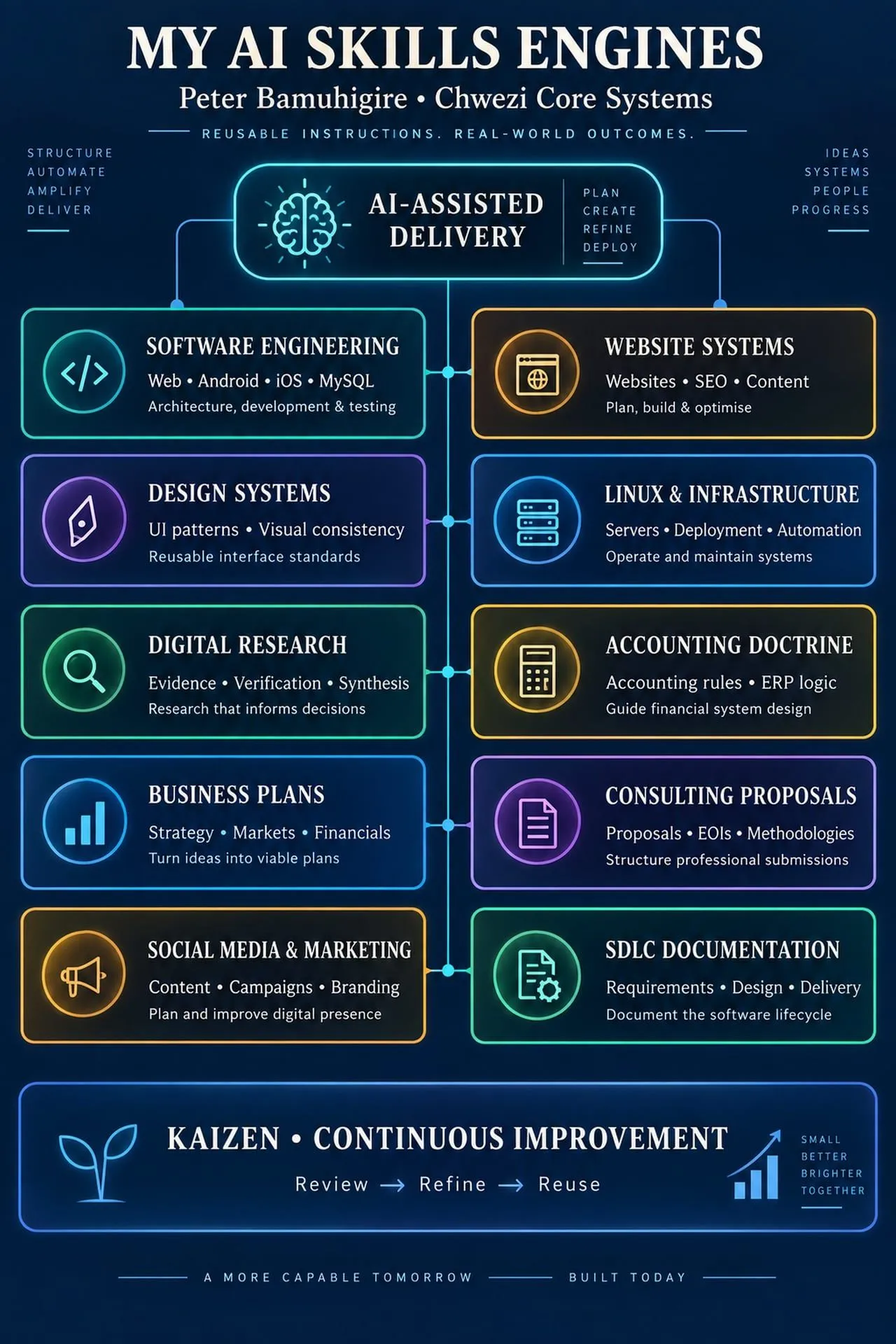
Software engineering, design systems, digital research, business plans, social media and marketing, website systems, Linux and Windows infrastructure, accounting doctrine, consulting proposals, and SDLC documentation all sit under the same AI-assisted delivery loop: plan, create, refine, deploy. None of it is treated as finished — Kaizen keeps every engine under continuous review, refinement, and reuse rather than freezing it at its first version.
What is an AI skills engine?
An AI skills engine is a structured catalogue of instructions, decision rules, evidence requirements, and quality gates that helps an agent or practitioner route work consistently. Each one packages as a Claude Code plugin and a Codex-compatible installer script, so I use the engines as the reasoning and control layer around AI tools — not as a magic prompt, an unsupervised replacement for specialists, or a claim that every task can be automated.
Use this directory when you need to
Want several at once? chwezi-engine-agents is a shared marketplace and installer for adding multiple engines as one suite.
My AI practice
I use an AI tool for the work it is good at — drafting, coding, classifying, comparing, summarising, or exploring — then use the relevant skills engine to decide what must be checked, what evidence is required, which specialist route applies, and where a person must approve the result. Human review is not an optional final polish; it is the control point in the workflow.
See the complete operating method →Context
The right engine gives the AI tool the job, constraints, inputs, and boundaries.
Evidence
Sources, tests, calculations, and repository facts keep fluent output from becoming false confidence.
Human in the middle
A person reviews, corrects, approves, escalates, rejects, stops, or rolls back consequential work.
Choose a route
Start with the problem you are trying to solve. Follow the website explanation for the install command and boundaries, then inspect the linked GitHub repository for the actual skills and references.
Software and AI engineering
Routes software work across AI applications, agents, RAG, architecture, APIs, databases, security, DevOps, SaaS, and frontend delivery.
186 SKILL.md files · Claude Code + Codex plugin

Evidence and source evaluation
A research operating system for investigation, OSINT, due diligence, source verification, analysis, synthesis, and decision-ready outputs.
61 SKILL.md files · Claude Code + Codex plugin

Requirements and SDLC documentation
Standards-driven documentation from vision and requirements through architecture, design, testing, deployment, operations, and governance.
160 SKILL.md files · Claude Code + Codex plugin

AI-assisted marketing operations
Strategy, content, campaigns, community, analytics, training, AI-assisted marketing, and reporting for Uganda and East Africa.
178 SKILL.md files · Claude Code + Codex plugin

Website strategy and delivery
A route from brief to maintainable website: information architecture, content, accessibility, performance, SEO, analytics, deployment, launch, and handover.
63 SKILL.md files · Claude Code + Codex plugin

Visual and interface quality
Typography, colour, composition, UX, interface design, content design, accessibility, visual assets, and anti-AI-slop design quality gates.
98 SKILL.md files · Claude Code + Codex plugin

Planning and investment readiness
Evidence-disciplined business plans, feasibility studies, market validation, financial projections, valuation, bankability, and implementation plans.
131 SKILL.md files · Claude Code + Codex plugin

Bids, tenders, and consulting proposals
Evidence-led proposals, tenders, EOIs, donor responses, methodologies, implementation plans, financial proposals, and compliance packs.
113 SKILL.md files · Claude Code + Codex plugin

Finance and accounting source of truth
Cross-cutting accounting and finance doctrine for ledgers, controls, reporting, budgeting, tax, audit, and finance-system integration.
108 SKILL.md files · Claude Code + Codex plugin

Safe Linux operations
Family-aware server operations for Debian/Ubuntu and RHEL systems, including Bash, networking, services, security, storage, backups, and recovery.
48 SKILL.md files · Claude Code + Codex plugin

Windows and Active Directory operations
Windows Server, Active Directory, PowerShell, hybrid identity, networking, security, storage, and fleet operations — the eleventh canonical engine.
21 SKILL.md files · Claude Code + Codex plugin
01 · Frame
Define the decision, audience, evidence, constraints, and consequence of getting the work wrong before selecting an engine.
02 · Route
Use one specialist engine where possible and add companion engines only when the work crosses into finance, visual design, research, engineering, or formal documentation.
03 · Verify
Check sources, review outputs, record uncertainty, test failure paths, and keep approval, release, and rollback decisions with accountable people.
Every engagement begins with a conversation. Book a consultation to explore how Peter's experience can serve your organisation.
 GitHub ↗