

Planning and investment readiness
Business Plan Skills: Evidence-Disciplined Planning and Bankability
A public business-planning engine for feasibility, market validation, financial projections, valuation, bankability, investor readiness, and implementation planning.
 Inspect on GitHub Business Plan Skills Suite
Repository facts verified locally on 22 August 2026
Install
Add it to Claude Code or Codex
This engine installs as a native plugin for Claude Code, and its scripted installer works the same way from Codex or any terminal.
Native Claude Code plugin
/plugin marketplace add https://github.com/peterbamuhigire/business-plan-skills
/plugin install business-plan@chwezi-business-plan
Manual install (Claude Code, Codex, or any agent)
git clone https://github.com/peterbamuhigire/business-plan-skills
cd business-plan-skills
./install.sh --scope project      # macOS / Linux / Git Bash
.\install.ps1 --scope project     # Windows PowerShell
Both installers are cross-platform (macOS, Linux, Git Bash, and PowerShell) and wrap the same underlying installer script.
Direct answer
Business Plan Skills turns a business, investment, nonprofit, feasibility, or execution question into a decision-ready plan and auditable delivery bundle. It separates verified facts, assumptions, estimates, inferences, unknowns, and hypotheses before assembling the narrative and financial logic.
Who it serves
Founders, owner-managers, NGOs, consultants, boards, investors, lenders, DFIs, and teams preparing a plan that must survive challenge.
131
Active SKILL.md files verified
Claude Code + Codex plugin
Installs as
/plugin install business-plan@chwezi-business-plan
Native command
UGX
Default currency
Non-negotiable operating rule
Human in the middle. Every time.
Nothing is considered finished merely because an AI tool or skills engine produced it. A responsible person reviews the facts, logic, sources, calculations, code, security, privacy, context, and quality of the output before it is published, deployed, submitted, or used to make a decision. For some actions, the engine must stop until the user explicitly types that they approve the action; approval must never be inferred from silence or a vague request.
Human responsibility: approve, correct, escalate, reject, stop, or roll back the work.
Engine responsibility: make the method, evidence, limits, review points, and approval pauses visible.
In practice
A second view of the work this engine supports
The visuals illustrate the domain; they do not replace evidence, controls, or the human review required before a consequential decision or action.
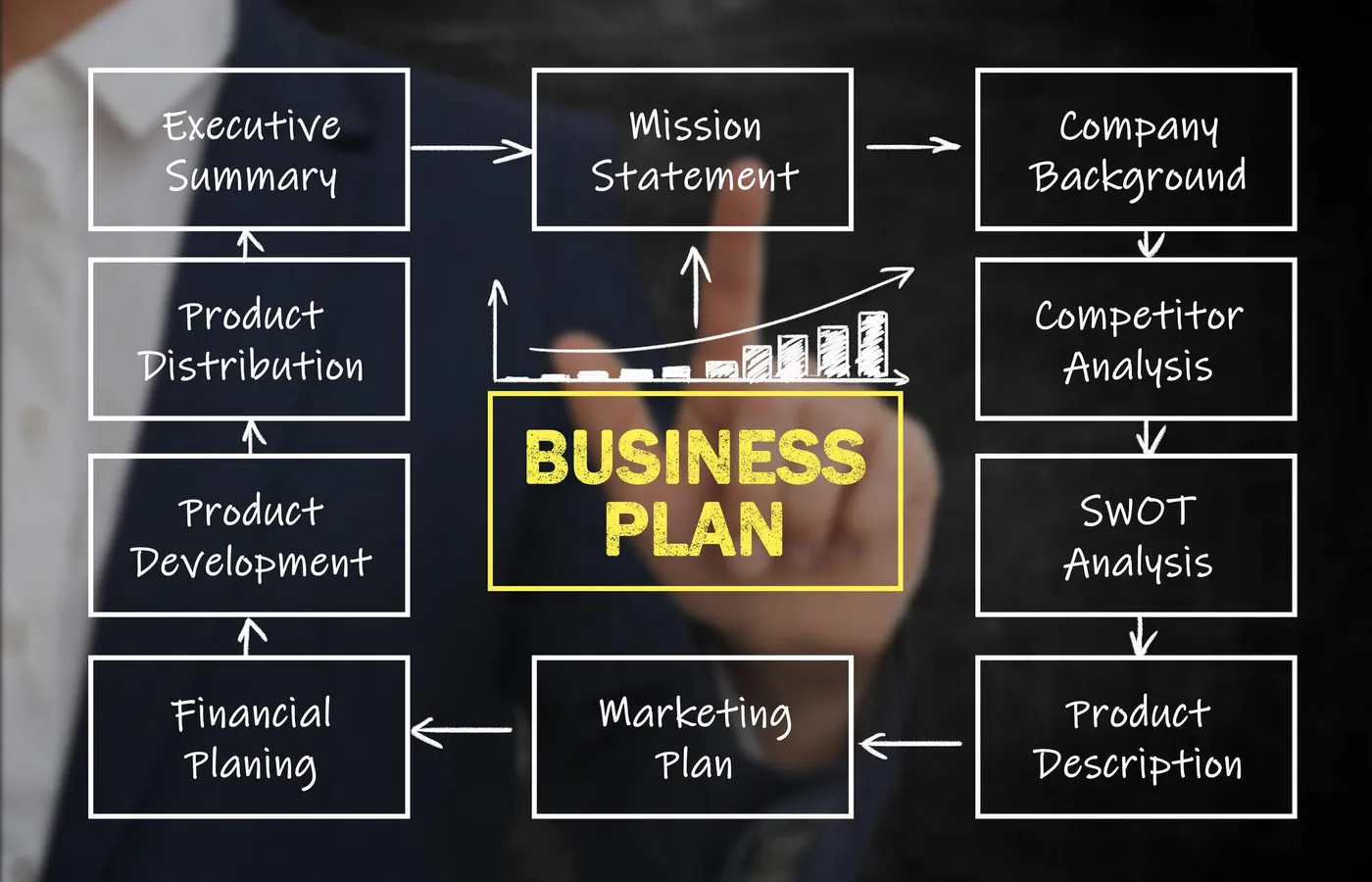
Capability map
What this engine covers
The list below is a plain-language summary of the repository's verified capability surface. It is not a promise that every project needs every skill.
- Bank, DFI, investor, grant, owner-manager, board, and strategic-partner business plans.
- Feasibility studies, business cases, market-entry studies, market validation, and Build-Measure-Learn experiments.
- Financial projections, unit economics, valuation overlays, bankability reviews, stress tests, and readiness packs.
- AI-enabled SaaS, ICT services, ecommerce, digital transformation, implementation timelines, and M&E frameworks.
How to use it
A repeatable route from request to evidence
Frame the decision
Define the audience, jurisdiction, sector, stage, funding instrument, scope, authority, constraints, and intended use.
Design the evidence
Build the claim register and evidence plan, then test demand, customers, channels, capability, regulation, risk, and finance.
Reconcile the model
Align the narrative, assumptions, operations, milestones, use of funds, cash flow, income statement, balance sheet, and scenarios.
Challenge and release
Run business-logic, evidence, finance, regulatory, risk, valuation, design, document, and audience gates before release.
Good fit
When to use this engine
- You need a bankable business plan, feasibility study, investor case, market-entry plan, or funding readiness pack.
- AI is being used to strengthen scenarios, assumptions, or structure without inventing numbers.
- A business plan needs a reconciled model, implementation roadmap, M&E indicators, and downside case.
- A plan crosses into accounting, proposals, research, software, or website work and needs controlled handoffs.
Boundaries
What it does not replace
- A plan is not called bankable, investor-ready, achievable, compliant, or submission-ready without the required evidence and professional reviews.
- AI can structure and stress-test inputs; it must not fabricate market facts, financial values, customer evidence, or approvals.
- Accounting, tax, IFRS/IAS, audit, and finance controls route to Chwezi Accounting Doctrine.
- It does not create evidence merely by writing confidently; source claims and project facts still need verification.
- It does not remove accountable human review, specialist judgement, approval authority, or professional sign-off.
- It does not authorise live account changes, client communications, production changes, or submissions without explicit permission.
Continue the route
Related first-party guidance
Chwezi Accounting Doctrine
Use the finance source of truth for accounting, ledger, controls, reporting, tax, audit, and finance-system questions.
Proposal Skills
Move a decision-ready plan into a tender, EOI, donor response, methodology, or financial proposal when required.
Business planning service
See the website service route for business-plan support in Uganda and East Africa.
Frequently asked
Questions about Business Plan Skills Suite
Can AI write a bankable business plan?
AI can help organise evidence, stress-test assumptions, compare scenarios, and draft structure. Bankability still depends on defensible inputs, financial logic, professional review, and release authority.
What makes this business-plan engine evidence-disciplined?
It requires a claim register, evidence plan, explicit assumptions, model reconciliation, challenge gates, and a clear distinction between fact, estimate, inference, and hypothesis.
Does it support East African planning?
Its default context is Uganda and East Africa, but country, sector, currency, funding instrument, audience, and regulatory context must be set through evidence-backed inputs.
Ready to discuss your project?
Every engagement begins with a conversation. Book a consultation to explore how Peter's experience can serve your organisation.