
Short answer
AI is most useful in African agribusiness as a risk-management tool, not a novelty. It forecasts yields and weather stress so you can plan cash flow, spots pests and disease earlier from photos, tracks market prices so farmers can time sales, and tightens the post-harvest chain. Start where your loss is biggest and the data already exists — and design for feature phones, patchy power, and the cooperatives that hold farmers' trust.
- Begin with your largest measurable loss, not the most exciting tool.
- Lab accuracy is not field accuracy — use AI to flag and triage, with an agronomist deciding.
- Better price information only pays if farmers can act on it through storage, transport, or bargaining.
A maize farmer rarely loses money in one dramatic event. The loss arrives quietly — a pest noticed a week too late, a harvest sold the day prices bottomed out, a store of grain that spoiled before it reached a buyer, a loan taken before a season that failed.
Agriculture is, at bottom, the management of risk under poor information. Climate variability, pests, price swings, and thin data make it one of the hardest businesses to run well anywhere — and harder still across Africa, where most food is grown by smallholders working with little more than experience and the weather they can see.
That is exactly where AI earns its place: not as a futuristic novelty, but as a way to reduce the cost of not knowing. Used well, it forecasts stress before it becomes loss, catches disease while it is still local, tracks prices so a farmer sells on a good day rather than a desperate one, and gives lenders and insurers a reason to back a crop they previously could not assess. Used badly, it is an expensive dashboard that no farmer can reach and no cooperative trusts.
For agribusinesses and the institutions that finance them, the right question is not "which AI platform should we buy?" It is: where is our biggest, most measurable loss, and is the data to attack it already within reach?
Forecasting yields and weather stress to plan cash flow
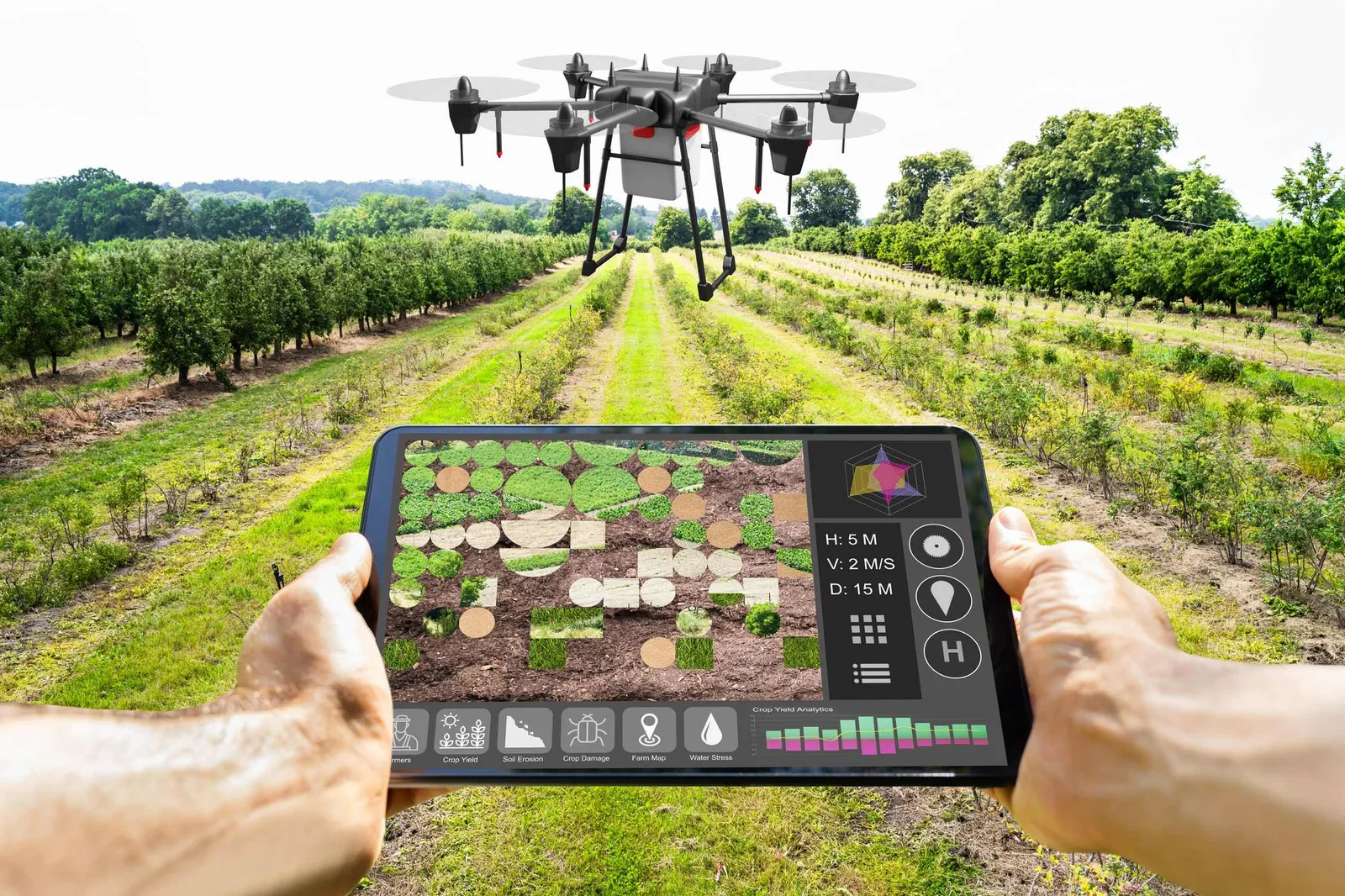
The first and least glamorous use of AI in agriculture is seeing trouble coming. Satellite imagery and weather models, processed with machine learning, can map cropland, flag drought stress, and estimate how a season is shaping up — weeks before a manual survey could.
Several of these systems are public and free. FAO's Agricultural Stress Index System (ASIS) flags drought-affected cropland every ten days at one-kilometre resolution, drawing on a record stretching back to 1984; it was recognised as a Digital Public Good in 2024. Digital Earth Africa publishes a continent-wide cropland map built from Sentinel-2 imagery, with regional accuracy ranging from about 84% in West Africa to 94% in North Africa. NASA Harvest contributes to the G20 crop-monitoring effort and has produced rapid national cropland maps — in Togo, an entire country mapped at 10-metre resolution in under ten days to target COVID-19 food relief.
Be precise about what these tools do, though. Most are monitoring and classification systems — they tell you where cropland is and where it is stressed — not crop-by-crop yield predictors with a guaranteed margin of error. Treat them as an early-warning radar for planning cash flow, ordering inputs, and timing credit, not as a promise of a precise harvest figure. The value is a better-informed plan, not a crystal ball.
This is also where advisory services reach real scale. CGIAR's AICCRA programme reported reaching nearly four million smallholder farmers across six African countries in 2023 with agro-climate advisories — the kind of "plant later this year, the rains are delayed" guidance that turns a satellite signal into a decision a farmer can act on.
Detecting pests and disease earlier from images
The most striking AI tool in African agriculture is also the one most often oversold. Smartphone apps can photograph a leaf and name the disease — and the headline accuracy figures are extraordinary. A landmark 2016 study trained on the PlantVillage dataset reported over 99% accuracy across 26 diseases.
That number is true and misleading at the same time. It was measured on clean, controlled images. In the field — mud, shade, mixed symptoms, an unsteady hand — accuracy falls sharply. The most honest evidence comes from PlantVillage Nuru, the cassava-disease app built by IITA and Penn State and now used to monitor disease across 19 African countries, offline. An independent 2020 evaluation in Tanzania and Kenya found Nuru diagnosed at about 65% accuracy — still better than the trained extension officers it was tested against, at 49%. But the detail matters: diagnosing cassava brown streak disease from a single leaf was only 21% accurate, rising to 73% when six leaves were assessed.
The rule that keeps you safe
Lab accuracy is not field accuracy. Use the app to decide where to look and to scout several leaves, not one — then let a human confirm before a farmer sprays, uproots, or quarantines a crop. AI flags; people decide.
Designed this way, image diagnosis is genuinely valuable. It puts a first-line screening tool in the hands of farmers and extension officers who cannot all be experts in every disease, and it works where it is needed most. The same approach extends to pests: FAO's Fall Armyworm Monitoring and Early Warning System (FAMEWS) turns field scouting and pheromone-trap counts into a live infestation map, and the eLocust3m app, built by PlantVillage with FAO, feeds desert-locust observations into forecasting that gives whole regions warning before a swarm arrives.
The pattern is consistent: AI is strongest as an early, wide-coverage alert — catching a problem while it is still local and cheap to contain — and weakest when treated as a final verdict.
Tracking market prices to time sales
Smallholders often sell at the worst possible moment — straight after harvest, when everyone else is selling and prices are lowest, because they need cash and lack storage. Market-information services attack this by delivering current prices from multiple markets, so a farmer or cooperative can decide where and when to sell.
These services are deliberately low-tech, because that is what reaches farmers. Esoko in Ghana delivers price information by SMS, voice, and USSD. Viamo's 3-2-1 service runs as a toll-free voice line in local languages on any phone — in Burkina Faso it has carried price information for sesame, shea, cashew, maize, rice, millet, and sorghum in Mooré, Dioula, and French. Ethiopia's commodity exchange pushes live market data to tens of thousands of farmers a day.
Here, honesty matters most. The evidence that price information raises the prices farmers actually receive is genuinely mixed. A matched study of Esoko found treated farmers got about 10% higher maize prices; a separate randomised trial found the same kind of alerts improved farmers' knowledge of prices without changing the prices they got. The foundational research is clearer that information reduces price dispersion across markets — Jensen's work on Kerala and Aker's on Niger both showed mobile phones flattening price gaps by 8–16%.
What this means in practice
Price information only pays if the farmer can act on it. Knowing the price is higher two districts away is worthless without transport; knowing it will rise next month is worthless without storage. The strongest results come when a cooperative pairs price data with aggregation, storage, and the bargaining power of selling together.
This is where AI adds the next layer: turning a raw price feed into a "sell now or wait" judgement by reading trends and regional gaps. But the recommendation is only as useful as the farmer's ability to act on it — which is a logistics and cooperative-organisation problem as much as a data one.
Tightening the post-harvest supply chain
Some of the largest losses in African agriculture happen after a successful harvest. The World Bank and FAO estimated post-harvest grain losses in Sub-Saharan Africa at around US$4 billion a year — enough food to meet the needs of at least 48 million people. That is value already grown, already paid for, and then lost to spoilage, poor storage, and broken logistics.
Digital and AI-enabled tools attack this chain at several points: demand matching and aggregated logistics so produce moves before it spoils, telematics on shared machinery so it is used efficiently, traceability so buyers will pay for quality, and cold storage placed where it is needed. ColdHubs, the solar-powered cold-room network in Nigeria, reports extending the shelf life of perishables from two days to about 21 and cutting post-harvest loss substantially, on a pay-as-you-store model of roughly US$0.50 per crate per day. Platforms such as Twiga Foods, Hello Tractor, and eProd digitise aggregation, machinery sharing, and farmer records across the chain.
Treat the scale figures these companies publish as their own claims rather than audited fact — but the underlying logic is sound: the cheapest harvest to save is the one you have already grown. For many agribusinesses, the post-harvest chain is where the biggest measurable loss sits, and therefore the best place to start.
Be honest about the prerequisites
Every use case above depends on three things that are easy to assume and dangerous to ignore: connectivity, data, and trust.
Connectivity is thinner than slide decks suggest. Only about 27% of people in Sub-Saharan Africa use mobile internet, and the region has the world's largest usage gap — most people who could be online are not. Rural adults are roughly half as likely to use mobile internet as urban ones, almost two-thirds of the region still uses a feature phone or a 3G handset, and only about a third of rural Sub-Saharan Africa has electricity. This is why the tools that actually work run over SMS, USSD, and voice, or sync offline at the cooperative. A solution that needs a modern smartphone and a steady charge reaches the farmers who need it least.
Farm-level data is scarce and fragmented. There is little reliable information on where small farms are, what they grow, or what they yield; the World Bank's long-standing estimate is that only about a tenth of Africa's rural land is formally registered. Useful data tends to live with cooperatives and aggregators — which is precisely why they, not a central app, are the right channel. FAO's support for a digital farmer register in Zambia, covering 4.3 million verified farmers each with a unique ID, is the model: build the record through the institution farmers already belong to.
Trust is the binding constraint. A farmer asked to photograph her crop, share her harvest data, or follow a planting advisory is being asked to trust a system she did not build. That trust lives in the cooperative and the extension officer, not in the software. It is also unevenly distributed: across Sub-Saharan Africa women are about 29% less likely than men to use mobile internet, and the financial-inclusion gender gap is twice the developing-country average — so a tool that quietly assumes a smartphone-owning male farmer will widen the very gaps agribusiness should be closing.
Reframing AI as the engine of agri-finance
For lenders, insurers, and cooperatives, the most consequential use of AI is not on the farm at all — it is in the decision to finance the farm. Agriculture is starved of credit because it is hard to assess: smallholder finance demand exceeds supply by roughly US$170 billion, and only about 5% of farming households in much of Sub-Saharan Africa hold any agricultural insurance.
Better information is what closes that gap. Index insurance pays out on a measurable external signal — a rainfall deficit, a satellite vegetation index — rather than inspecting each field, which removes the cost that made smallholder cover uneconomic; Pula reports insuring more than 20 million farmers on this principle. The same weather, yield, and mobile-money signals feed digital credit scoring used by lenders such as Apollo Agriculture and FarmDrive to underwrite farmers with no formal collateral or credit history. The forecasting and monitoring described above also provide the data that lets an institution lend and insure where it previously saw only risk.
Where to start: a practical maturity path
Most agribusinesses and cooperatives do not need an expensive AI platform to begin. They need a clearly named loss, the data that already exists, and one controlled pilot. The path below moves from the unglamorous foundations to scale — and refuses to skip a step.
Start where the loss is biggest
Name your largest, most measurable loss — produce spoiling before sale, selling at the bottom of the price cycle, disease that spreads before anyone notices, or loans that default after a bad season. Begin there, not with the most impressive demo.
Use the data that already exists
Satellite imagery, weather grids, mobile-money records, cooperative registers, and market-price feeds already exist — much of it free. FAO ASIS drought data and Digital Earth Africa cropland maps cost nothing. You rarely need to start by collecting new data.
Pick one use case, one crop, one season
Forecasting, image-based diagnosis, price timing, or cold storage — choose one, for one crop, and evaluate it within a single season. A pilot you cannot judge in 90–120 days is too big.
Design for feature phones and patchy power
Most smallholders are not on a smartphone with reliable electricity. Build on SMS, USSD, voice/IVR, and offline-capable apps. A tool that needs 4G and a full battery will reach the farmers who need it least.
Work through the cooperative or aggregator
The cooperative holds the trust, the membership list, and the delivery records. Route training, data collection, and advisories through it. Tools that bypass the aggregator usually fail on adoption, not technology.
Keep a human agronomist in the loop
AI flags; people decide. A phone photo is a prompt to scout, not a verdict. Diagnose from several leaves, not one, and let an extension officer confirm before a farmer sprays or uproots a crop.
Scale only after proof
If the pilot cut the loss you targeted in one season — less spoilage, better-timed sales, earlier disease detection, fewer defaults — expand it cooperative by cooperative. If not, fix the data or the process before spending more.
The decision test for leaders
Before approving any AI project in agriculture, an agribusiness or agri-finance leader should be able to answer five questions in plain language. If the vendor cannot answer them, the project is not ready.
- Which exact loss will shrink, and how will we measure it in one season?
- Does the data we need already exist — and who holds it, the cooperative or a platform?
- Will it reach a farmer on a feature phone with no reliable power, or only a smartphone owner?
- What will the tool be forbidden to decide on its own — and where does a human agronomist confirm?
- Does it narrow or widen the gap for women, rural, and first-time farmers?
AI will not make African agriculture less risky by being clever. It will make it less risky by helping people see loss coming, act on it sooner, and finance it more fairly — starting where the loss is biggest and the data already exists.
The agribusinesses and lenders that get this right will not be the ones with the most impressive demo. They will be the ones that respected the old truth of farming: information is worth most when it reaches the person in the field in time to change what they do.
This article sits beside two practical next steps: clean your business data before you buy AI, and govern it well with the playbook in responsible AI without digital dependence. To pressure-test an AI use case for your agribusiness, cooperative, or agri-lender, get in touch.
Frequently asked questions
Is AI realistic for smallholder farming in Africa given poor connectivity?
Yes, if it is designed for the real conditions. Only about 27% of Sub-Saharan Africans use mobile internet, and rural adults are roughly half as likely to be online as urban ones, so the useful tools reach farmers over SMS, USSD, and voice/IVR on ordinary phones, or through offline apps synced at the cooperative. The intelligence can run on a server; the farmer only needs a feature phone and a message they can act on.
Can an app reliably diagnose crop disease from a phone photo?
It can triage, not diagnose with certainty. Lab studies report very high accuracy — over 99% on clean dataset images — but real field accuracy is much lower. Independent testing of PlantVillage Nuru in Tanzania and Kenya found about 65% accuracy in 2020, and diagnosing cassava brown streak disease from a single leaf was only 21% accurate, rising to 73% when six leaves were assessed. The honest use is to flag suspect plants for a human to confirm, and to scout several leaves, not one.
Will market-price information actually get my farmers better prices?
Sometimes, and only if they can act on it. One matched study of Esoko in Ghana found treated farmers received about 10% higher maize prices, but a separate randomised trial found price alerts raised farmers’ price knowledge without raising the prices they received. The difference is whether a farmer can store the crop, reach another market, or bargain. Price data is a tool for timing sales, not a guarantee of a better price.
What is the best first AI project for an agribusiness or cooperative?
Start where the loss is biggest and the data already exists. For many that is post-harvest — spoilage and badly timed sales destroy value you have already grown — or early disease detection, where catching an outbreak a week sooner saves a season. Avoid starting with the most complex forecasting model; start with the loss you can measure and a use case you can evaluate in one season.
How does AI help the lenders and insurers who finance agriculture?
It reduces the cost of not knowing. Index insurance pays out on a measurable signal such as a rainfall deficit or a satellite vegetation index, instead of inspecting every field, which makes cover affordable to scale — Pula reports insuring over 20 million farmers this way. The same weather, yield, and mobile-money signals also feed digital credit scoring used by lenders like Apollo Agriculture. With smallholder finance demand outstripping supply by roughly US$170 billion, better information is what lets institutions lend and insure where they previously could not.
Do we need to buy expensive AI software to start?
No. The foundations are free or cheap: public satellite and drought data, a single well-chosen use case, and the cooperative as the channel to farmers. Most agribusinesses get further by cleaning their own records and acting on free agro-climate advisories than by buying a platform before they know which decision they want to improve.
Key takeaways
- AI is a risk-management tool for agribusiness, not a novelty — it helps you lose less and finance more.
- Start where the loss is biggest and the data already exists, not with the most impressive tool.
- Forecasting and monitoring data are an early-warning radar for planning, not a precise harvest figure.
- Image diagnosis is a triage tool: lab accuracy is not field accuracy, so scout several leaves and let a human confirm.
- Price information only raises income when farmers can act on it through storage, transport, or collective bargaining.
- Connectivity, data, and trust are prerequisites — design for feature phones and route everything through the cooperative.
- For lenders and insurers, the same data underpins index insurance and digital credit scoring that close the finance gap.
Sources and researchers worth crediting
Treat these as a research trail. Accuracy figures are reported with their field-versus-lab context; company scale figures are the firms' own claims unless independently verified. Verify the current publication before relying on any single source.
- World Bank / FAO / NRI — Missing Food: Postharvest Grain Losses in Sub-Saharan Africa (2011)
- IPCC AR6 WGII, Chapter 9: Africa (2022)
- GSMA — The Mobile Economy Sub-Saharan Africa 2024
- GSMA — State of Mobile Internet Connectivity 2024
- NASA Harvest — crop monitoring and yield models
- Digital Earth Africa — Cropland Extent data
- FAO GIEWS — Agricultural Stress Index System (ASIS)
- CGIAR AICCRA — climate-smart agriculture in Africa
- Mohanty, Hughes & Salathé (2016) — deep learning for plant disease detection
- Mrisho et al. (2020) — Nuru field accuracy for cassava disease
- IITA & Penn State PlantVillage — NuruAI
- FAO — Fall Armyworm Monitoring & Early Warning System (FAMEWS)
- Courtois & Subervie (2015) — market information and farm-gate prices
- Aker (2010) — mobile phones and grain markets in Niger
- ISF Advisors — Pathways to Prosperity: smallholder finance (2019)
- World Bank Blogs — financial risk management in African agriculture
Further sources consulted: David Hughes, Marcel Salathé and the Penn State PlantVillage team; IITA cassava research; Ramcharan et al. (2017, 2019) on Nuru; Hildebrandt et al. (2015) and Jensen (2007) on market information; ISF Advisors and the World Bank Global Findex on smallholder finance; and, for the Francophone adaptation, the CILSS / AGRHYMET Regional Climate Centre, CORAF, BCEAO, and Senegalese agri-tech (mLouma, Tolbi).
About the author
Peter Bamuhigire
Software architect and ICT consultant — business management systems across Africa
Peter Bamuhigire has led ERP, SaaS, and custom software programmes for organisations in Uganda, Kenya, Rwanda, DRC, Senegal, Sierra Leone, and Guinea over the last fifteen years, and runs the practice as principal architect.