
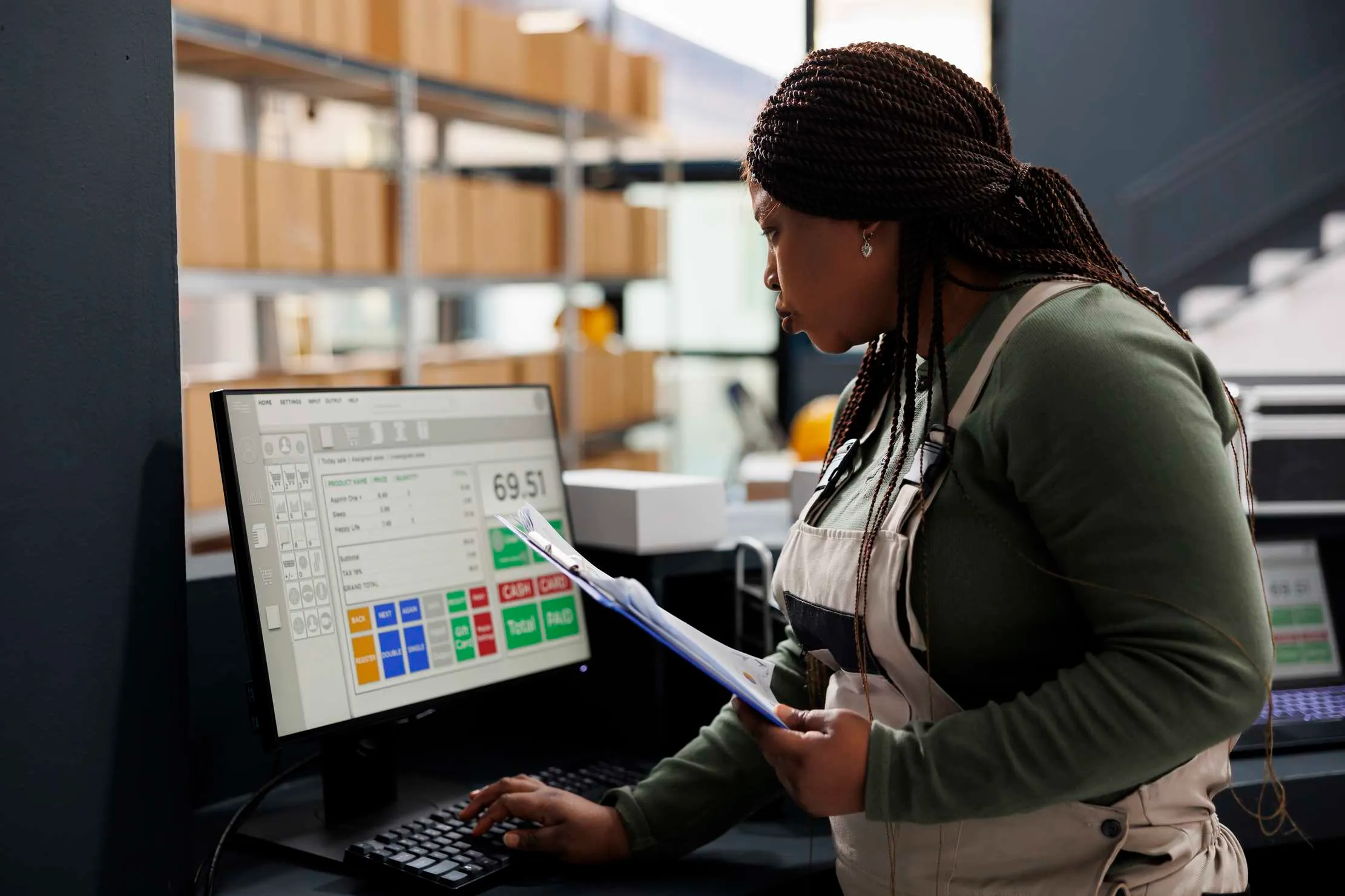
A woman I know runs a hardware shop in Naalya, on the outskirts of Kampala. Last year, she called me at 9 PM on a Saturday. She had spent the entire evening counting bags of cement by torchlight because the power was out and her exercise book records didn't match what was on the shelves. Forty-three bags were missing. Not stolen in one go — lost slowly, over months, through a combination of uncounted sales, unrecorded credit, and stock that walked out the door when nobody was watching.
Forty-three bags of cement at UGX 32,000 each. That is UGX 1,376,000. Roughly $370. For a shop operating on thin margins, that figure represents an entire month of profit.
Her situation is not unusual. It is the default.
The Notebook Problem
Walk into most small businesses across East Africa and you will find the same system: a counter book, a calculator, and someone's memory. The shop owner writes down sales when they remember. Credit customers get a torn receipt or a name scribbled in the margin. Stock counts happen once a month if they happen at all. Expenses get lumped together because there is no simple way to categorise them.
This works — until it doesn't.
The moment your business grows beyond what one person can hold in their head, the notebook becomes a liability. You can't tell which products make money and which sit collecting dust. You don't know how much credit is outstanding or who has been owing you for six months. You can't prove your revenue figures when the tax authority comes asking.
I have consulted for businesses across more than 10 African countries over 15 years. The pattern is identical whether I am in Kampala, Nairobi, Kigali, Dakar, or Freetown. Businesses that run on paper and memory lose between 5% and 15% of their revenue to errors, theft, and missed collections. Most owners don't even realise the money is gone because they have no system to measure it against.

POS: Know What Sells and What Sits
A Point of Sale system does more than print receipts. It is the eyes and ears of your business.
Every sale gets recorded instantly. You see what sold, when it sold, how much it sold for, and who sold it. By closing time, you do not need to count cash and hope the numbers add up. The system tells you exactly what should be in the till.
Here is what that means in practice. A pharmacy in Kampala I worked with discovered that one of their three cashiers was consistently short by UGX 50,000 to 80,000 per shift. They only found this because the POS system tracked every transaction against each cashier's login. Before the system, they assumed the shortfalls were counting errors. The total over six months? More than UGX 7 million — roughly $1,900.
A POS system also tells you what to stock. When you can see that Brand X paracetamol outsells Brand Y by three to one, you stop wasting shelf space on Brand Y. When you notice that cement sales spike every Friday afternoon, you make sure deliveries arrive Thursday morning. These are not sophisticated analytics. They are basic sales data that every business needs and that a notebook simply cannot provide.
For businesses with multiple branches or multiple staff on the counter, a POS system is not optional. It is the difference between knowing what your business does and guessing.
Inventory: Stop the Invisible Leaks
Stock shrinkage is the silent killer of African SMEs. It comes in three forms, and all three thrive in the absence of a digital system.
Theft. Small, repeated pilferage by staff or customers. A packet here, a bottle there. No single incident is large enough to notice, but the total over a year can be staggering. A retail shop without inventory tracking loses an average of 3% to 5% of stock value to theft annually.
Expiry and damage. Products that sit too long on shelves expire or deteriorate. Without a system that tracks batch dates and flags items approaching expiry, you only discover the loss when you physically inspect the shelf — by which point, the money is already gone.
Dead stock. Items you ordered too many of, that don't sell, and that tie up cash you could use elsewhere. A digital inventory system shows you exactly how long each item has been sitting and helps you make clearance decisions before the capital is completely wasted.
I built Maduuka specifically to address this problem for small and medium businesses. It tracks every item from the moment it enters your store to the moment it leaves. Stock levels update in real time. When quantities drop below a threshold you set, the system alerts you. When items approach expiry, you see them flagged on your dashboard before they become write-offs.
The return on investment is straightforward. If your business turns over UGX 50 million per month and you are losing 5% to shrinkage, that is UGX 2.5 million per month — UGX 30 million per year. A digital inventory system that cuts that loss even in half pays for itself many times over.

HR and Expenses: Where Money Disappears Quietly
Beyond sales and stock, two areas bleed money from small businesses almost invisibly: payroll and expenses.
Payroll errors. A restaurant with 12 staff members calculates salaries by hand each month. Overtime hours get estimated. NSSF and PAYE deductions get rounded. Advance payments get forgotten. By the end of the year, the cumulative error can amount to hundreds of thousands of shillings. And when URA asks for your PAYE records, a pile of handwritten payslips is not an answer they accept.
Untracked expenses. Fuel, airtime, repairs, packaging, transport. Small business owners pay for dozens of things every week that never make it into any record. At the end of the month, the question is always the same: "Where did the money go?" Without a system that captures expenses as they happen, you will never get a clear answer.
A proper business system handles both. Staff records, attendance, salary calculations, statutory deductions — all computed accurately and consistently. Expenses logged against categories so you can see exactly where your money goes. This is not about being a big corporation. It is about knowing your own numbers.
Customer Intelligence: Who Buys Most, Who Owes What
Here is a question every business owner should be able to answer instantly: who are your top 10 customers by spending? And how much credit is currently outstanding across all your customers?
Most can't answer either question.
Credit management. In many African markets, selling on credit is not optional — it is how business works. But managing credit on paper is a recipe for losses. Customers dispute amounts. Owners forget to follow up. Debts age beyond any reasonable collection period. A digital system tracks every credit sale, sends payment reminders, and shows you at a glance who owes what and for how long.
Customer loyalty. When you know that a particular customer spends UGX 500,000 per month with you, you treat them differently. You can offer them better prices, priority service, or a loyalty discount — not as a vague gesture, but as a calculated business decision backed by data. That customer stays loyal because you recognise their value.
Buying patterns. A car repair garage that tracks customer visits digitally knows that a particular client brings their vehicle every 5,000 kilometres. They can send a service reminder before the customer even thinks about it. A market stall that tracks purchases knows which customers buy in bulk on the first of the month and can prepare their orders in advance.
These are basic features in systems like Maduuka that are built for exactly this kind of African business environment.
The Tax Man Is Already Digital
Even if every reason above did not apply to you, this one will. Governments across Africa are moving to mandatory electronic tax systems. If your business is not digital, you will soon be non-compliant.
Uganda — EFRIS. The Electronic Fiscal Receipting and Invoicing System, managed by the Uganda Revenue Authority, now requires VAT-registered businesses to issue electronic fiscal receipts for every transaction. This is not a suggestion. It is law. Businesses that fail to comply face penalties, and URA is actively auditing.
Kenya — eTIMS. The electronic Tax Invoice Management System requires businesses to generate tax-compliant invoices electronically through KRA's system. Since 2024, all VAT-registered taxpayers must use eTIMS for every sale.
Rwanda — EBM. The Electronic Billing Machine system, run by the Rwanda Revenue Authority, has been mandatory for years. Every sale must produce an electronic receipt linked to RRA's servers.
Tanzania — VFD. The Virtual Fiscal Device system requires all VAT-registered businesses to issue electronic fiscal receipts through TRA-approved devices or software.
The direction is clear across the continent. Paper receipts and manual record-keeping will not satisfy tax authorities for much longer. A digital POS and accounting system does not just help your business — it keeps you on the right side of the law.
And here is the practical reality: when URA or KRA audits your business, they will ask for transaction records, stock reports, and expense breakdowns. If your answer is a stack of counter books, the audit becomes adversarial. If your answer is a clean digital report generated in minutes, the audit becomes a formality.

Getting Started: It Is Simpler Than You Think
I understand the hesitation. You have run your business on paper for years. It works well enough. The thought of learning new software feels like a burden you don't need.
But consider what "well enough" actually costs you. The missing stock you can't account for. The credit you have given up trying to collect. The customers who left because a competitor offered better service. The tax penalty you might face next year when the EFRIS auditor arrives and your records don't match.
The good news is that going digital does not mean buying an expensive ERP system designed for multinational corporations. It means finding a system built for businesses like yours.
Maduuka is a business management platform I built specifically for African SMEs. It handles POS, inventory, customer management, expenses, and basic HR — in a single system that works on any device with a browser. It supports multiple currencies for businesses operating across borders, and it is designed for the realities of doing business in East Africa: intermittent connectivity, mobile money payments, and local tax requirements.
For businesses in the property sector, Aqar Property Software does the same for landlords and property managers — tenant records, rent tracking, maintenance scheduling, and financial reporting, all in one place.
Both systems come from the same philosophy: practical tools that solve real problems for real businesses. No unnecessary complexity. No features you will never use. Just the core functions that stop you losing money and start giving you control.
If you are not sure where to start, get in touch. I have spent 15 years helping businesses across more than 10 African countries move from paper to digital systems — from single-counter shops to multi-branch operations. The first step is always a conversation about where your business is today and where the gaps are. That conversation costs you nothing. The cost of doing nothing, on the other hand, grows every month.
The Choice Is No Longer If, But When
The hardware shop owner in Naalya? She now runs Maduuka on a tablet behind her counter. Every sale is recorded. Every bag of cement is tracked from delivery to sale. Her credit customers have clear balances that she reviews every Monday morning. Her last stock count matched her system records within 2%.
That is what going digital means. Not fancy dashboards or imported jargon. Just knowing your numbers, protecting your stock, managing your customers, and sleeping better at night because your business is no longer running on memory and hope.
The tax authorities are already digital. Your competitors are going digital. Your customers expect it. The question is not whether your business will go digital. The question is whether you will do it on your terms, or be forced into it when the cost of waiting becomes impossible to ignore.
Peter Bamuhigire
Technology and Business Consultant with over 15 years of experience across more than 10 African countries. Builder of Maduuka and Aqar. Based in Kampala, Uganda.
Get in Touch